
What Nick Jonas Gets Right About Loving an Indian Woman
Every once in a while, pop culture gives us a moment that feels light on the surface but carries something much deeper underneath.
Recently, Nick Jonas posted a casual Instagram video of himself eating dosa and vibing to a Bollywood song—and not just any song. The track playing in the background was Teri Dulhan Sajaoongi from the film Barsaat, starring none other than his wife, Priyanka Chopra Jonas, alongside Bipasha Basu. It was playful, unforced, and joyful. And for many South Asians watching, it landed differently—not because it was flashy, but because it was deeply personal.
This wasn’t performative. It was consistent.
Anyone who has followed Nick and Priyanka over the years knows this moment fits into a much larger pattern—one that quietly challenges some of the deepest fears South Asian families and singles carry around love, marriage, and cultural preservation.

Instagram/NickJonas
This Isn’t a Phase—It’s a Pattern
Nick Jonas embracing Indian culture didn’t start with an Instagram Reel, and it certainly didn’t stop there. Over the years, we’ve watched him repeatedly travel to India with Priyanka—not just for milestone moments, but as part of their regular life together. We’ve seen him dance enthusiastically at family weddings, participate in rituals, learn Hindi lyrics, collaborate on songs like “Meri Jaan” by King, and show up for celebrations with genuine excitement rather than polite restraint.
What makes this meaningful is not any single moment, but the continuity between them. South Asian women—and men—are especially attuned to this distinction. There is a clear difference between someone who merely tolerates your culture and someone who actively participates in it. Tolerance sounds like, “I don’t mind if you do that.” Participation sounds like, “Teach me. I want to understand. I want to be part of this.”
Nick doesn’t announce his efforts or over-explain them. He simply shows up, again and again. That consistency is what makes his engagement with Priyanka’s culture feel authentic rather than performative.
Loving an Indian Woman Is Not About Exoticism
One of the most common fears South Asian women express when dating outside the culture is the concern that they are being chosen for an idea rather than their reality. There’s often a quiet question sitting in the background: Do they actually like me, or do they just like what I represent?
Nick’s relationship with Priyanka offers a powerful counterexample. He does not treat her culture like an accessory or a novelty. He doesn’t dilute it to make it more comfortable for himself, nor does he expect Priyanka to minimize her Indianness in order to fit into his world more seamlessly. Instead, her culture remains central to their shared life—visible, celebrated, and respected.
This distinction matters deeply in South Asian dating. There is a meaningful difference between cultural curiosity and cultural consumption, between respect and fetishization, and between a partnership built on equality versus one shaped by subtle power imbalances.
In many ways, that quiet moment of him enjoying her music captures the essence of real partnership—not trying to lead the song, not rewriting the lyrics, but learning the rhythm well enough to move together.
The Contrast We Rarely Talk About
Nick Jonas comes from a background that, on paper, looks very different from Priyanka’s. He was raised in a deeply American context, within a Christian upbringing, in a family whose cultural reference points don’t naturally overlap with South Asian traditions. Yet what stands out in their marriage is not the difference itself, but the absence of conflict around dominance.
There is no visible tug-of-war over whose culture leads or whose identity takes precedence. There’s no sense that one partner’s background must shrink to make room for the other’s. And that absence is precisely what so many South Asian women fear—not marrying outside the culture, but losing themselves inside the marriage.
Their relationship quietly demonstrates something powerful: integration does not require erasure. It requires intention.
The Lesson South Asians Often Miss—Even When Marrying “Within”
This is where the conversation turns inward for the South Asian community.
Many families say they want their children to marry “within the culture,” but in practice, that often translates into increasingly narrow requirements: same language, same region, same religious sect, same food habits, same family style. Historically, these preferences made sense. Homogeneity helped preserve culture during times of migration, vulnerability, and survival.
But in today’s context, those same filters often function less as protection and more as fear—fear of difference, fear of discomfort, and fear of change. Ironically, many people who marry within all the “right” boxes still struggle with emotional compatibility, communication, and mutual respect.
Shared demographics do not automatically produce shared values, emotional safety, or a healthy partnership.
What Actually Preserves Culture Today
Culture survives not because it is rigidly guarded, but because it is lived. It endures when it is practiced with joy rather than obligation, shared willingly rather than enforced, and modeled in everyday life rather than anxiously protected.
Nick embracing Indian culture does not dilute it—it normalizes it. It sends a quiet but powerful message that Indianness is not fragile, that it doesn’t need to be preserved through restriction, and that it can expand without disappearing.
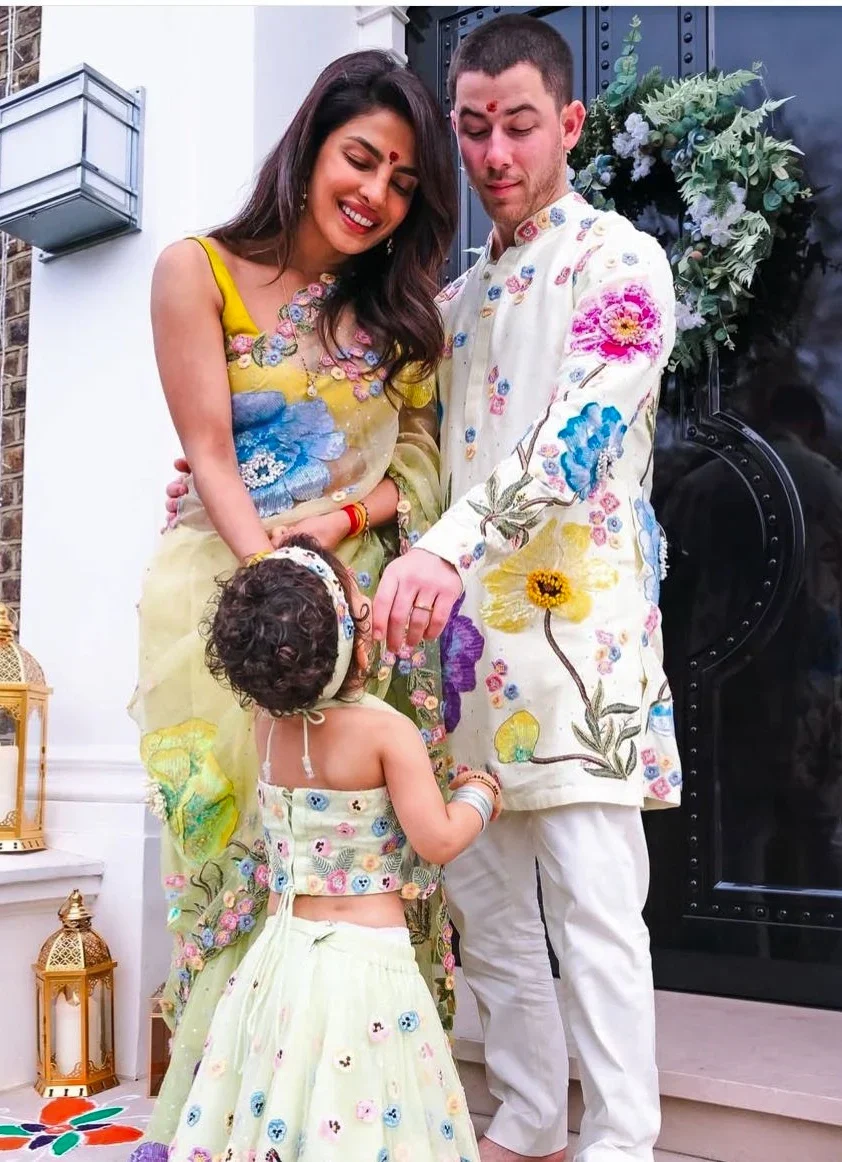
Priyanka & Nick with daughter Malti
For South Asian families raising children in the diaspora, this is a critical reframe. Culture doesn’t survive by shrinking the world—it survives by teaching the next generation how to carry it forward with confidence.
Raising Children With Abundance, Not Anxiety
Nick and Priyanka’s daughter will grow up seeing Indian culture modeled as something joyful rather than defensive. She will learn that difference is something to approach with curiosity, not fear, and that identity is something you live rather than justify.
That lesson extends far beyond celebrity families. It applies to every South Asian parent trying to pass on language, faith, and tradition in a world that looks vastly different from the one they grew up in.
Children don’t need perfect cultural symmetry. They need emotional safety, consistency, and pride in where they come from.
A Reframe Worth Sitting With
You do not lose your roots by choosing love.
You lose your roots when you marry someone who resents them, when you’re asked to make yourself smaller to keep peace, or when your culture becomes a temporary phase instead of a lasting foundation.
The original goal of marrying within the community was never rigid sameness. It was continuity, stability, and shared life. Those goals are still valid—but the methods can evolve.
In today’s world, intentional partnership preserves far more than rigid homogeneity ever could.
And that may be the most important lesson a simple dosa video quietly delivered.