
When Beauty Becomes a Battleground: Why so Many Indian American Women Still Chase Western Standards
Recently, a viral TikTok by content creator Saumya Gopal (@tallbrowng1raffe), an Indian American woman based in Dallas, sparked a firestorm online. In her video, she celebrated her heritage—her thick hair, strong nails, lush eyelashes, smooth skin—and framed these features as the gift of “Indian genetics.”
What should have been an affirming moment quickly devolved into controversy. Many accused her of arrogance. Others felt she was taking an unnecessary dig at the Black community, suggesting that Black beauty is somehow “manufactured.” The creator herself seemed surprised by the backlash, but for those of us who’ve grown up navigating Western beauty standards, the reaction wasn’t entirely unexpected.
This incident lays bare a truth that often goes unspoken: Indian American women are constantly pulled between pride in our heritage and the deep, lingering insecurity of having been colonized—not just politically, but aesthetically. (For context, The Juggernaut did an excellent deep-dive into the controversy here.)
Why are so many of us obsessed with looking like white women?
It’s not as simple as wanting to “fit in.” Our longing to approximate whiteness runs generations deep. For nearly 200 years, the British told our ancestors that fair skin was superior, European features were desirable, and anything darker, broader, or more textured was primitive. Colonial rulers enforced hierarchies that placed white bodies on a pedestal—smoothed, polished, delicate—and our communities internalized those beliefs.
Even after Independence, Bollywood perpetuated the fantasy: heroines with lighter skin tones, straighter hair, narrower noses. Decades of skin-lightening ads promised that fairer skin would bring love, wealth, and status. Parents, often with the best intentions, repeated these messages at home. “Stay out of the sun—you’re getting too dark.” “Lose weight if you want to get married.” “Maybe straighten your hair—it looks messy.”
This is why, even today, Indian women in America often feel they have to compete on two fronts:
Against each other—who can look most like the Bollywood ideal?
Against white women—who set the “default” beauty standard that everything else is measured against.
It’s a cruel paradox: We’re judged for trying to look “white,” but we’re also punished for looking too Indian.
Dating only magnifies this struggle.
Apps are flooded with coded language—“No curry smell,” “Open to all but prefer fair skin,” “Exotic look.” You might hear backhanded compliments on first dates:
“You don’t even look Indian.”
“You’re pretty for your background.”
“Are your eyelashes real?”
These are not harmless observations. They are reminders that we are seen as deviations from the norm—beauty that is worth acknowledging only when it aligns with whiteness.
Yet the desire to belong is so powerful that many women absorb these messages without questioning them. In the process, they spend thousands of dollars on skin treatments, laser hair removal, chemical relaxers, colored contacts, and cosmetic procedures. They curate every inch of their appearance to make it more palatable to a gaze that was never designed to celebrate them.
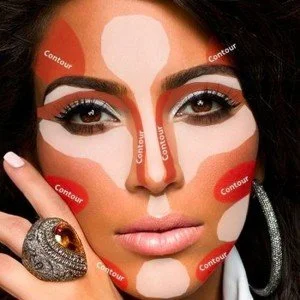
How to contour like a Kardashian
We also have to talk about the male gaze. Indian American men are not immune to these same ideals; many openly prefer women who look more "Western"—who straighten their hair, lighten their skin, or adopt the polished, contoured aesthetic popularized by the Kardashians. Today, it's no longer just about fair skin and thinness. It's about thick brows, full lips, and curves in exactly the right places. The pressure to keep up with these trends—whether it's contouring, lash extensions, or achieving the perfect "snatched" look—can be overwhelming.
But here’s the truth:
No amount of whitening cream or Botox can erase the legacy of colonial trauma. The longing to be seen as beautiful by Western standards is not a personal failing. It is the echo of centuries of colonization telling us that our bodies—our brownness—are not enough.
If you are an Indian American woman dating today, know this: You have every right to celebrate your beauty without apology. Your hair, your skin, your features are not shortcomings. They are the living testament to your ancestry, to the women who survived empires, partition, racism, and immigration so you could be here.
Three reflections to hold close as you date:
Western beauty standards were never meant to include you.
They were created to exclude and diminish. You don’t need to contort yourself to meet them.Self-acceptance is an act of defiance.
Every time you reject a product, a treatment, or a comment that tells you you’re not enough, you chip away at a system built to profit from your insecurity.Your worth is not conditional.
The right person will not expect you to erase your heritage to make them comfortable.
When you date from a place of grounded self-respect, you make room for the kind of love that celebrates you fully—your culture, your history, your beauty—without compromise.
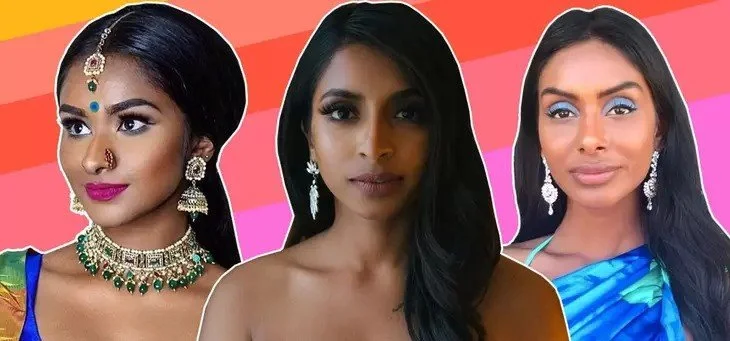
Melanin Queens Of Instagram