
When Love Looks Like Control: What the Bill Belichick-Jordon Hudson Saga Teaches Us About Power, Vulnerability & the Illusion of Choice

Bill Belichick poses with girlfriend Jordon Hudson on Feb. 6, 2025 in New Orleans. Kevin Mazur / Getty Images
Over the past few months, headlines have been swirling with updates about Bill Belichick—the legendary former Patriots coach—and his much younger partner, Jordon Hudson. At first glance, it's the age gap (he’s 73, she’s 24) that captures public curiosity. But if you look closely, this relationship is raising far deeper questions—not about scandal or celebrity, but about what happens when power, aging, and vulnerability collide in intimate partnerships.
I first stumbled upon their story during a CBS News interview where Belichick, once the calculated, commanding face of the Patriots dynasty, was being oddly coached off-camera by Hudson. When the interviewer asked a simple question about how the two met, rather than sharing their previously publicized "sat next to each other on an airplane" origin story, Hudson abruptly halted the interview. The optics were jarring—not romantic, not protective, but almost managerial.
The Shift From Leader to Puppet?
We’ve since learned even more unsettling details: Hudson has reportedly demanded control over Belichick’s wardrobe, business decisions, and even how he appears on camera. She’s allegedly been banned from UNC athletic facilities, where Belichick now coaches, for inappropriate involvement in his professional life. And most recently, she told at least one person they were engaged, even though Belichick himself hasn’t confirmed it.
What’s even more concerning is how his HBO show was canceled, with insiders hinting at behind-the-scenes dysfunction. Then there’s his increasingly bizarre public appearance, like a recent interview where Belichick wore a rumpled hoodie and confused demeanor that felt far removed from his once-impeccable image. On social media, his posts—clearly managed or influenced by Hudson—range from uncharacteristically upbeat to downright strange.
From the outside, it looks less like a romantic partnership and more like a takeover. Which brings me to what I really want to talk about: what happens in a relationship when one partner's identity starts to erode—whether from aging, trauma, loneliness, or a desire to feel young again—and the other partner, knowingly or unknowingly, fills that void with control disguised as care.
Aging, Power & the Hidden Vulnerability of Older Partners
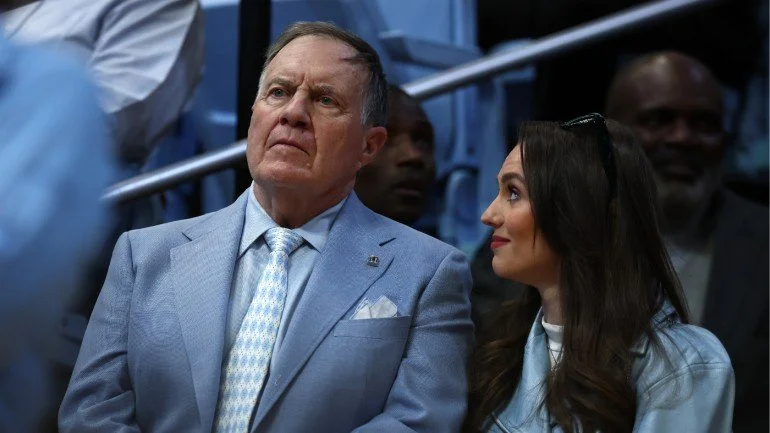
The business of Bill Belichick reportedly runs through Jordon Hudson these days. (Photo by Jared C. Tilton/Getty Images)
We don’t talk enough about how emotional vulnerability increases with age, especially for high-functioning, formerly high-powered individuals like Belichick. We assume older people are wise and self-aware, but that’s not always the case—especially if their inner world hasn’t caught up with their outer accomplishments.
When someone has led with dominance their entire life, the loss of relevance, sharpness, or physical vitality can be deeply destabilizing. In that state, they might not be as discerning about who they let in—and more importantly, who they give power to.
And make no mistake: control often masquerades as intimacy. What starts as “I’ll help manage your affairs” can quickly turn into “You can’t make decisions without me.” In Desi relationships, we sometimes see this dynamic when a younger partner (or even a well-meaning child) begins “taking over” an older person’s life under the guise of support.
But support is not the same as ownership. And love should never come with a loss of agency.
Gender, Age Gaps & Manipulation in South Asian Dating

A painter in Massachusetts turned an online photograph of Mr. Belichick and Ms. Hudson into a painting. At Ms. Hudson’s request, he changed the sign on the beach to say “The Belichick Way.” Credit...Ryan McFee
In South Asian dating culture—especially within intergenerational or second-time marriages—this dynamic is worth watching. When we see a much younger woman involved with a significantly older man, our culture tends to default to judgment: “She must be a gold-digger.” But in this case, there’s also the real concern of cognitive decline, like early-onset dementia, or even the simple psychological impact of growing older in a world that prizes youth and virility.
It’s easy to laugh at this situation or write it off as a celebrity oddity. But I encourage you to think deeper. Ask yourself:
Have I ever seen a relationship where someone loses themselves in the name of love?
Do I know someone older—perhaps a parent, uncle, or respected elder—who may be emotionally vulnerable and becoming overly reliant on someone new in their life?
Am I, or someone I care about, mistaking control for affection in my own dating life?
In matchmaking, I’ve seen this unfold firsthand. Whether it’s a younger woman “managing” an older man’s image or an older man grooming a much younger partner into compliance, unequal power doesn’t lead to love—it leads to dependency. And dependency, unlike love, breeds resentment, secrecy, and imbalance.
The Takeaway: Watch the Power, Not Just the Age
The Belichick-Hudson saga isn’t just a tabloid curiosity. It’s a case study in what happens when relationships become lopsided—not just in years, but in autonomy, influence, and identity.
So if you're navigating the dating world—especially post-divorce or in your 40s and 50s—don’t just look for compatibility. Look for clarity of intention, mutual respect, and a relationship that preserves your personhood, not replaces it.
You deserve someone who sees your full self—not just what they can gain from you.