
Behind Closed Doors: When Private Arguments Go Public in Power Couples
What the Macrons—and Our Own Aunties—Can Teach Us About Conflict, Culture, and Saving Face
This week, the world witnessed a moment of unintended vulnerability from one of the most high-profile couples in global politics. As French President Emmanuel Macron exited a plane with his wife Brigitte, a short video clip captured what looked like a mid-argument moment: she appears to shove his face, he looks stunned, and within seconds—almost as if a switch flipped—he composes himself and resumes his public persona.
Later, Macron claimed it was playful. Just a moment of jest. But those of us who work with couples or who have been in long-term relationships know: body language doesn’t lie. That wasn’t banter. That was tension leaking through the cracks.
And that’s when I realized—this moment, as European as it appears, is deeply Desi in spirit.
The South Asian Struggle with Public Conflict
In our community, the concept of “log kya kahenge” or “what will people say?” is more than a saying—it’s a survival instinct. We are taught from a young age to maintain appearances, to never air dirty laundry, and to treat relationship issues like family secrets.
Who among us hasn’t seen an uncle and auntie arrive at a party after yelling in the car, only to hold hands and smile for the photos?
Or the newly married couple who had a major argument before their engagement shoot—but still posted a #blessed caption for Instagram?
In many Desi households, the performance of peace matters more than the experience of it.
And when that illusion breaks—when a shove, a sharp comment, or even a telling silence is witnessed by others—it’s not just awkward. It feels like failure. Because so much of South Asian couplehood is about optics: being the successful duo, the power couple, the couple whose love story is “filmy” enough to make the aunties and your cousins swoon.
But real relationships aren’t reels. And sometimes, they get messy.
When Conflict Goes Public
Whether it’s Macron being shoved on camera, or a newlywed couple having a meltdown in the Costco parking lot, public conflict triggers something ancient in us. It makes us feel exposed. Vulnerable. Weak.
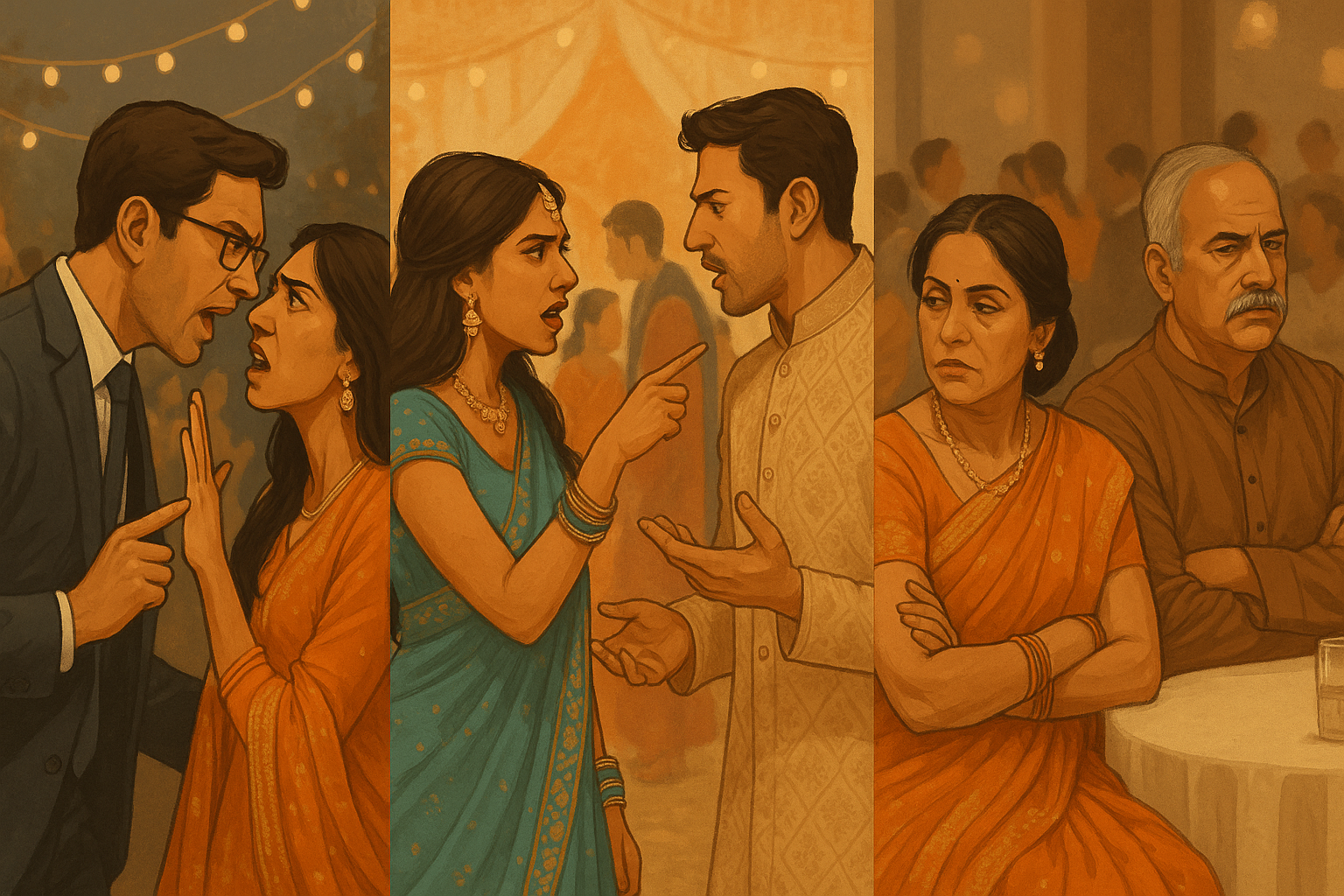
Image created by ChatGPT
And in a culture that tells us to “keep it in the family,” that’s terrifying.
Let me give you a few scenarios from the South Asian world that maybe we've all seen in our communities or families:
A high-profile couple from the diaspora—a tech founder and a well-known fashion blogger—got into a loud fight at a Diwali gala. He called her “too obsessed with social media,” and she accused him of “never showing up.” They were ushered outside by relatives, but the whole room felt the tension. Months later, they separated. Many in their circle said they were “shocked.” But for those who paid attention, the cracks had been visible long before that night.
A middle-aged couple at a wedding in Edison, NJ were seen giving each other the cold shoulder all night. No dance together, no photos, and barely a shared word. Guests whispered, “Maybe he’s having an affair.” The truth? They were deep in the throes of eldercare burnout, both exhausted from managing aging parents. But because they hadn’t learned how to fight productively—or share their struggles—they became strangers in plain sight.
A recently engaged couple in Mumbai, whose families had arranged the match, found themselves arguing at a mehndi function. She didn’t want to wear the family heirloom necklace; he insisted it would offend his mother. The disagreement escalated—quietly, but visibly. They were told to "adjust" and "not ruin the vibe." Two years later, they were divorced, citing “fundamental incompatibilities.”
What These Moments Reveal
In every one of these scenarios, there was an unspoken tension: The fear that if we argue in public, people will question our love and we'll lose our image of having the "perfect relationship".
But here’s the truth: real love includes real conflict. Not the kind that wounds or humiliates, but the kind that emerges when two people, with different histories, values, and triggers, try to build a life together.
And while public conflict might feel shameful in the moment, it can actually be a wake-up call—a signal that something isn’t being addressed in private.
What matters isn’t whether couples argue, but how they repair.
From “Saving Face” to Saving the Relationship
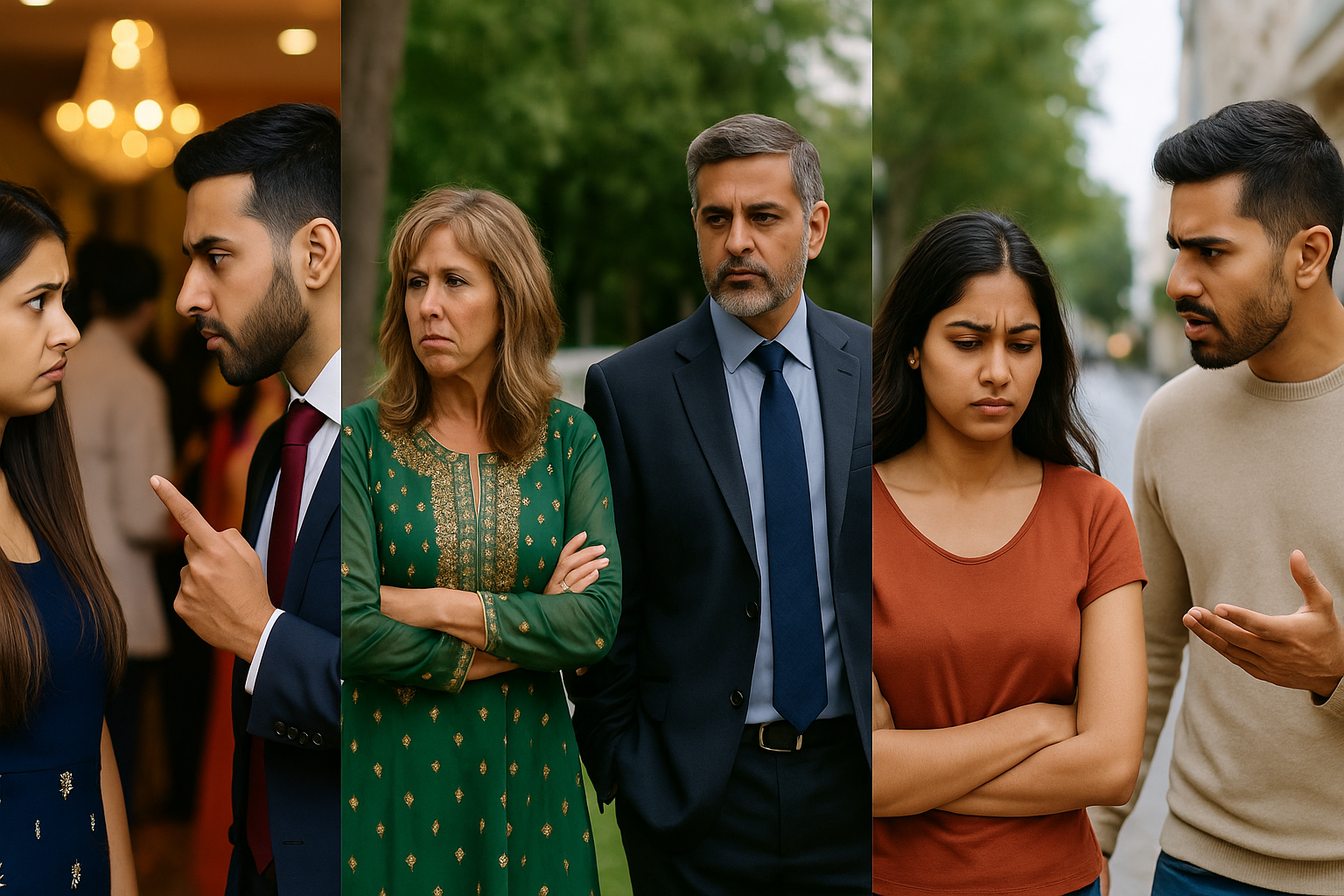
Image created by ChatGPT
If the Macrons teach us anything this week, it’s this: no matter how polished a couple appears, none of us are immune to moments of tension. And instead of shaming those moments, we should study them.
Ask:
Did we resolve the disagreement, or did we just smooth it over for the audience?
Was this moment a one-off—or a pattern?
Do I feel emotionally safe in this relationship when conflict arises?
And most importantly:
Are we more committed to looking like the perfect couple… or being one?
Creating Room for Realness
At Single to Shaadi, I often remind my clients: a great marriage is not made in the mandap. It’s made in the days, weeks, and years after—when the honeymoon glow fades, the mundanity of life sets in, and you’re left with the sacred work of choosing each other, again and again. That's why we have a podcast in the Single to Shaadi Podcast Network called "Love Marriage" which focuses on successful couples, after they have been married.
So if you’re single and watching couples stumble, don’t be disillusioned. Be curious.
If you’re in a relationship and recognizing some of these patterns—don’t panic. Start talking.
And if you’re a couple who just had your own “Macron moment,” here’s what I want to say: you’re not alone. But don’t sweep it under the rug. Sit down, look each other in the eye, and begin again.
Because love isn’t about never faltering. It’s about how you recover—together.